
Running a Check in New Jersey
The official New Jersey Sex Offender Internet Registry is the starting point for a statewide check. It is the public layer of Megan's Law, not the complete police registration file. NJSP operates the Internet system and reviews records submitted through all 21 county prosecutor offices. Municipal police handle most registration and verification work. County prosecutors assess risk, propose the tier and notification scope, and take disputes to Superior Court.
That chain matters when a result looks wrong. A public user should report a precise field issue to the registering police agency or county prosecutor rather than draw a conclusion from the statewide screen. Use the New Jersey county directory to reach the correct local records site. The county sheriff is not the default registering office in New Jersey. Where a municipality has no local department, the county prosecutor can identify the law enforcement agency that performs the function.
New Jersey Registry No-Result Limits
A no-result search does not establish that no registered person lives near an address or that a named person has no registration duty. New Jersey publication turns on statute and court orders. Tier 3 profiles are public. Tier 2 profiles are generally public, subject to narrow exceptions and court findings. Tier 1 profiles ordinarily do not appear online, although repetitive-and-compulsive findings can affect publication.
Spelling, aliases, recent agency updates, a move, and a changed court order can also affect what the query returns. Treat the online result as the set of currently published records matched by the search, not a full census. Confirm a possible match through the official photograph, aliases, physical details, address, offense, and disposition information. Shared names alone are weak evidence.
According to the NJSP registry source shown here, the state provides a public search and map interface without requiring a fee or login.
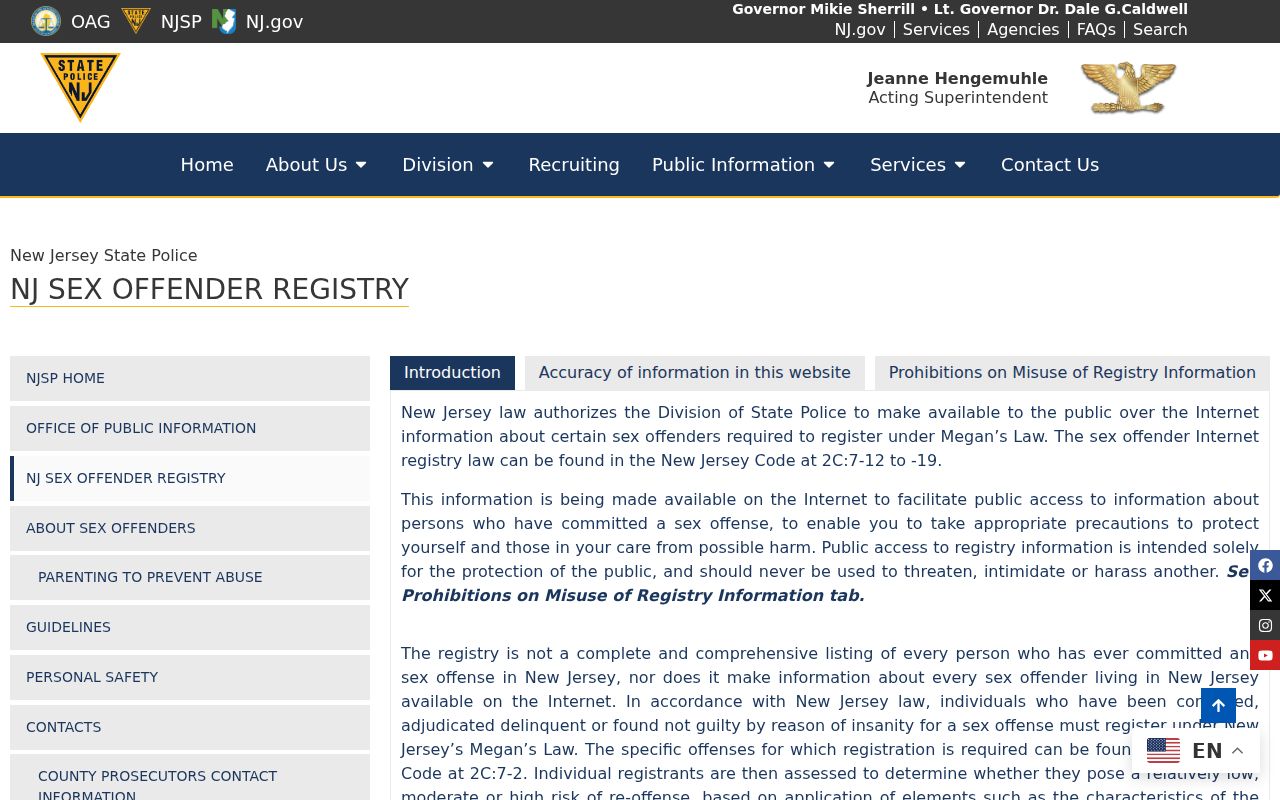
The image shows the official entry point, while the legal publication limits still govern every set of results.
Note: A New Jersey registry profile is a notification record, not proof of a new offense, current custody, or an active warrant.
Searching the New Jersey Sex Offender Internet Registry
The official vendor-operated New Jersey search interface supports several distinct paths. Area mode looks for published profiles around a street location. Name mode accepts a first and last name and can return partial matches across primary names and aliases. City mode provides a wider locality view. The Internet-name or email mode calls for an exact match.
- Accept the official warning and choose area, name, city, or exact Internet-name and email mode.
- Enter only the fields needed for that mode. Retry a known alias or spelling when a name query is too narrow.
- Open a possible New Jersey match and compare the photograph, aliases, physical details, offense, disposition, and registered address.
- Enroll a valid street address and confirmed email if ongoing location alerts would help with community awareness.
| Field Label | Type | Required | Notes |
|---|---|---|---|
| Address, City, State, ZIP | Text and dropdown | Yes for area mode | Uses a real location; ZIP+4 is optional |
| Offender Address Type | Selector | Not stated | The inspected interface exposed home addresses |
| Last Name, First Name | Text | No | Primary and alias names; partial matches |
| City | Text | Not stated | Returns partial matches |
| Internet Name or Email | Text | Not stated | Exact match only |
| Area Radius and Map | Map search | Address fields | Returns published profiles within the selected radius |
| Email Alerts | Enrollment | No for search | Tracks published records near a saved address |
Note: The New Jersey interface did not expose fixed radius values during inspection, so choose only options the live form displays.
New Jersey Registry Address Alerts
The free official registry address-alert enrollment is built for a specific New Jersey street address. It asks for address, city, state, ZIP, email, confirmation email, and acknowledgment of the notification contract. A post office box is not accepted. The responsible law enforcement agency sends the alert, and the service says a confirmation should arrive within 24 hours. Check junk or bulk folders if it does not appear.
An alert supplements a fresh official search. It does not promise a fixed refresh interval, cover records barred from Internet publication, or replace an emergency call. Use 911 for an immediate threat. Direct a suspected registration violation to local police or the county prosecutor's Megan's Law Unit, with facts rather than public accusations.
What a Profile Shows
NJSP's Megan's Law guidance and the official New Jersey citizen guide define the public profile and notification limits. Not every field appears in every record. The offense and disposition describe a past legal event, while the address and photograph are registration data. Neither proves current custody or a new offense.
| Name & Aliases | Primary name and known aliases used to refine identity |
|---|---|
| Photograph & Description | Photo date, age, race, sex, height, weight, hair, eyes, scars, and tattoos where published |
| Registered Address | Street address, ZIP, municipality, and county |
| Offense Details | Qualifying offense, disposition date and place, brief description, and statutory victim-age categories |
| Risk Tier | Low, moderate, or high risk determination that helps set notification scope |
| Other Published Fields | Vehicle details and the separate published noncompliant status tool where applicable |
For the underlying judgment, use PROMIS/Gavel or the county court record. For custody, use the county jail, NJDOC, or federal locator that fits the case. Those systems answer different questions from a New Jersey registry profile.
Note: Profile fields vary by record, and the photograph date may differ from the date of the underlying New Jersey disposition.
New Jersey Registry Office Chain
New Jersey divides registry work among four actors. Municipal police register and verify the person. The county prosecutor evaluates risk and proposed notification. Superior Court hears a challenge to tier or scope. NJSP reviews the submitted record and publishes qualifying data through the statewide interface. Sending every issue to a sheriff or NJSP can slow the answer.
Address changes and verification are handled in person. Ordinary registrants verify annually. A person found repetitive and compulsive verifies every 90 days. A move within New Jersey requires notice to the current agency and the intended municipality at least ten days before the move, followed by re-registration. A person moving into or returning to New Jersey registers within ten days. Failure to register or re-register is a third-degree crime.
Note: Moving within the same New Jersey municipality or county does not remove the duty to report and re-register as required.
Registration Requirements and Levels
New Jersey tiers measure risk and determine who receives notice. They are not federal SORNA duration classes. Registration is presumptively for life, subject to a court petition path and statutory exclusions. An eligible person may petition Superior Court under N.J.S.A. 2C:7-2(f) after showing no offense for 15 years following conviction or release, whichever is later, and no likely threat to others. The passage of 15 years does not produce automatic removal.
| Level / Tier | Duration | Verification and Notice |
|---|---|---|
| Tier 1, low risk | Presumptively life; petition may be available | Usually annual; notice to law enforcement likely to encounter; ordinarily not online |
| Tier 2, moderate risk | Same presumptive-life framework | Usually annual; adds likely schools, licensed day care, camps, and registered groups; generally online |
| Tier 3, high risk | Same presumptive-life framework | Usually annual; adds public members likely to encounter; online |
| Repetitive and compulsive finding | Controlled by statute and court findings | Verification every 90 days; can affect publication |
More than one sex-offense conviction and specified serious convictions can bar the termination route. The New Jersey Supreme Court's 2024 R.H./T.L. decision addressed how the conviction-worded 15-year prong applies to juvenile adjudications, but applicants still must satisfy the safety prong. It was not a blanket deletion rule.
New Jersey Community Notification
Internet publication and community notification are not the same. Tier 1 notice is limited to law enforcement likely to encounter the person. Tier 2 expands the recipients to likely schools, licensed day care centers, summer camps, and registered community groups. Tier 3 also reaches members of the public likely to encounter the person within the court-approved area. Police and county prosecutors conduct the targeted notice.
The prosecutor and court determine the geographic and recipient scope. Cross-county notice is coordinated when the likely-to-encounter area crosses boundaries. A controlled notice is not freely republishable merely because a related profile may appear online. New Jersey also has no general statewide Megan's Law school or park distance buffer. Courts held local buffer ordinances preempted, though an individual supervision condition can impose a tailored limit.
New Jersey and National Searches
A location or person that crosses state lines calls for a second official layer. The National Sex Offender Public Website searches participating jurisdictions, but each state still controls which profiles it publishes. A national no-result therefore carries the same basic warning: it is not proof that no registration duty exists.
The federal source shown below provides a broad jurisdiction search without replacing New Jersey's own registry.
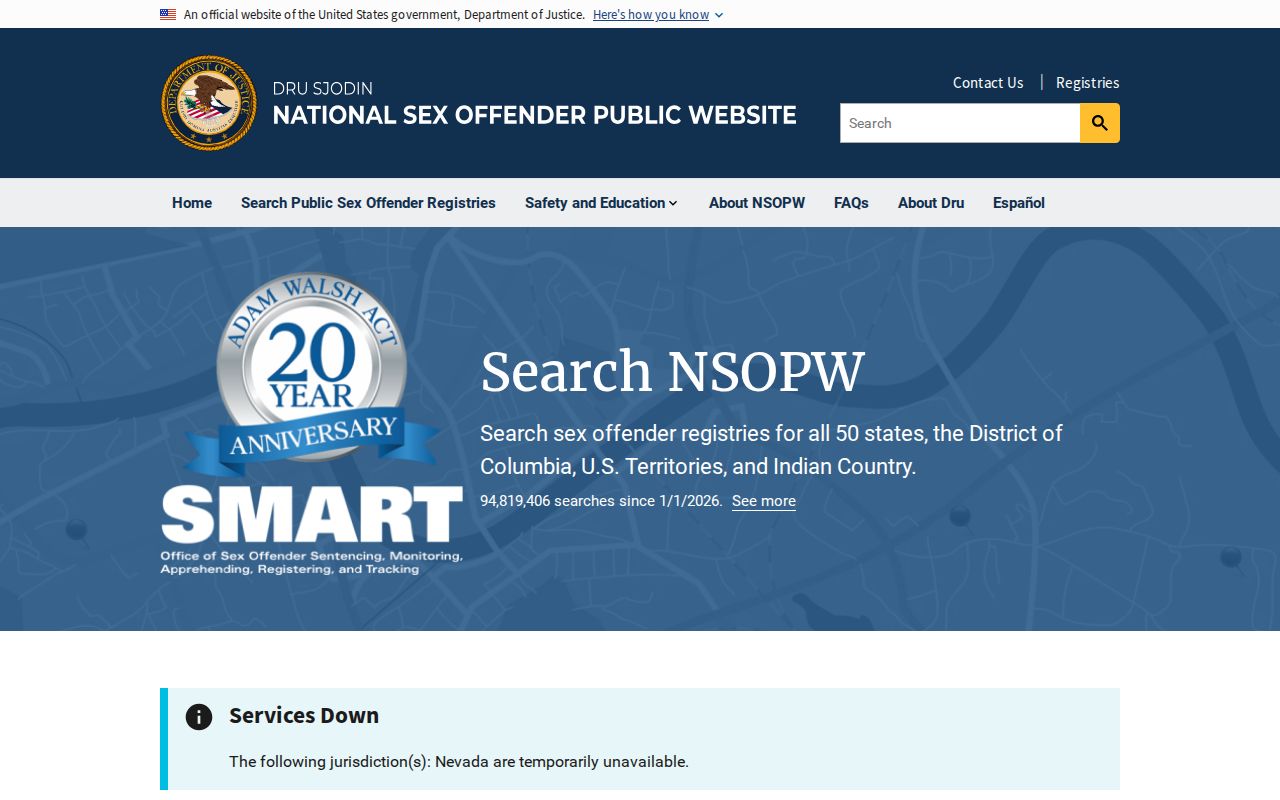
The national interface is most useful for moves and other cross-state concerns, followed by verification on each jurisdiction's official registry.
When a registrant moves out of New Jersey, compliance here does not finish the destination state's process. Contact that registry before the move and follow both sets of timing rules. A profile disappearing after relocation does not prove that the legal duty ended.
Lawful Use
The New Jersey registry exists for safety awareness. Do not contact, confront, follow, threaten, intimidate, or harass a listed person. Under N.J.S.A. 2C:7-14 and 2C:7-16(b), misuse can lead to criminal prosecution and civil liability. Using registry information to commit a crime is a third-degree crime. Using it to commit a disorderly or petty disorderly persons offense is itself a disorderly persons offense.
Misuse is a crime. Use New Jersey registry information for awareness, not retaliation; report suspected noncompliance to police or the county prosecutor.
Personal information may be removed for a time when registry use or threatened use causes harm, threats, intimidation, or harassment, then restored when practical. A careful New Jersey sex offender check stops at official verification. Law enforcement, not a member of the public, investigates possible violations.