
Criminal Cases in the New Jersey Courts
New Jersey divides criminal work by offense and stage. Municipal Courts hear disorderly persons and petty disorderly persons offenses, ordinance cases, DWI matters, and traffic charges. They also handle many complaints and first appearances. Indictable first-, second-, third-, and fourth-degree crimes proceed in the Superior Court of New Jersey, Law Division, Criminal Part. Each county is part of a Judiciary vicinage, so an indictable case remains tied to its county of venue even though the court system is run statewide.
The court trail can continue beyond the trial court. Criminal Part judgments go to the Superior Court Appellate Division for direct review, while the New Jersey Supreme Court is the state court of last resort. The Judiciary Criminal Practice Division connects the statewide criminal programs and record routes. PROMIS/Gavel does not merge municipal files or replace the source case jacket. The relevant court keeps the filed documents.
Federal cases are separate. The U.S. District Court for the District of New Jersey hears federal trial matters, and appeals go to the Third Circuit. Dockets use PACER, while CourtListener's RECAP collection may supply donated documents. None of those cases appears as a state prosecution in PROMIS/Gavel.
New Jersey Criminal Court Levels
A common search error is treating every charge as a Superior Court case. New Jersey uses different systems for indictable and municipal work. A prosecutor may screen an indictable complaint, dismiss it, send it to a grand jury, or downgrade and remand it to Municipal Court. A remand means the matter returned to municipal handling. It does not mean the accusation became a conviction.
| Court | Criminal work | Next review |
|---|---|---|
| Municipal Court | Disorderly persons, petty disorderly persons, ordinances, traffic, DWI, complaints and first appearances | Superior Court Law Division |
| Superior Court Criminal Part | Indictable crimes, PTI, Recovery Court, pleas, trials and sentences | Appellate Division |
| Appellate Division | Review of criminal judgments and allowed interim matters | New Jersey Supreme Court |
Search both court layers when the path is unclear. A missing PROMIS/Gavel result may point to municipal venue, not to the absence of a case.
Note: New Jersey court level and final charge matter more than the offense label first written on a complaint.
How to Search PROMIS/Gavel Public Access
The free PROMIS/Gavel Public Access interface covers indictable Superior Court criminal information across all 21 New Jersey counties. The Judiciary's PROMIS/Gavel operational overview describes tracking from initial arrest through disposition and appellate review, but older, archived, sealed, impounded, and municipal-only matters may not appear. Treat a result as an index.
- Choose the defendant search or the case-identifier mode that matches the information in hand.
- Enter the legal last name, first name, and optional middle initial. Try a known alias separately.
- Use the county filter or an indictment, accusation, or case identifier to separate same-name results.
- Compare status, charge, event, and disposition entries. Do not treat the first charge as the final result.
- Request the public case jacket or a certified record from the appropriate Criminal Division Records Room.
| Field Label | Type | Required | Notes |
|---|---|---|---|
| Search by Defendant | Tab or mode | One mode | Public person search |
| Last Name | Text | Yes in name mode | Use the legal surname |
| First Name | Text | Portal-specified | Narrows common-name matches |
| Middle Initial | Text | No | Useful identity check |
| County | Dropdown | No | Choose among all 21 counties |
| Case identifier | Text or separate mode | Yes in identifier mode | Indictment, accusation, or case format varies |
The official PROMIS/Gavel source also shows the public search screen captured below.
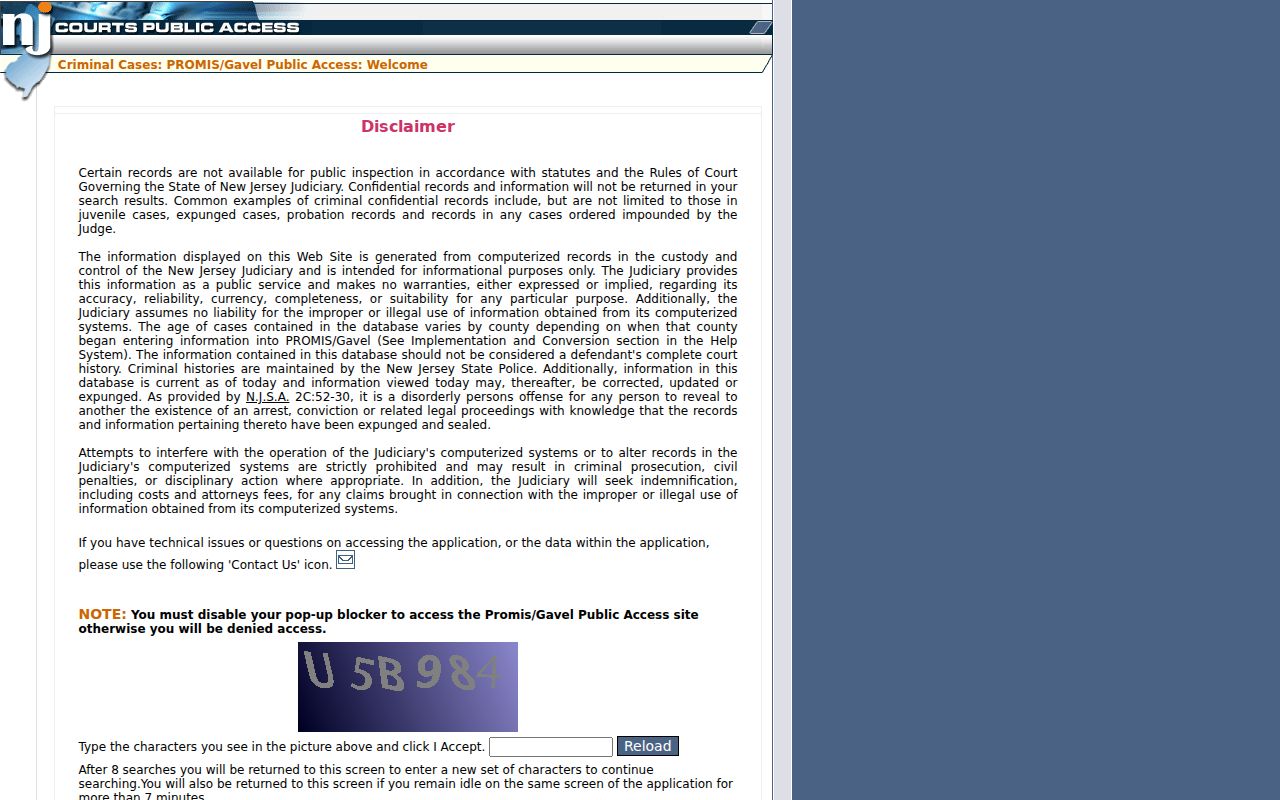
The form's name, county, and case-number paths show why a precise identifier is more reliable than a broad name query.
New Jersey Municipal Case Search
PROMIS/Gavel is statewide, but it is not universal. The Municipal Court Case Search is the next channel for disorderly persons and petty disorderly persons complaints, ordinances, DWI, parking, and traffic matters. This separate search is vital when prosecutor screening sends an allegation back to Municipal Court. It also explains why an indictable search can produce no match while a live complaint still exists.
Municipal results are not SBI rap sheets. They are court summaries for matters in the municipal system. Individual filings may still require a request to the named court. Confirm the complaint number, venue, current charge, and final disposition. If the same event later appears in PROMIS/Gavel, compare dates and identifiers before assuming there are two separate cases.
Note: A remanded New Jersey charge may require both court searches to reconstruct its path and final result.
What the Case File Shows
A New Jersey criminal case file can carry much more than its online index. Filed charging papers identify the accusation. Docket entries show motions, hearings, pleas, trial steps, and other court action. The final judgment states the offenses and sentence. Some financial terms, credits, probation conditions, and certified outcomes are authoritative only in the file or judgment. Public access does not include every item exchanged by the parties, because unfiled discovery is not a court record merely because it was shared.
| Case Number & Court | County, Criminal Part venue, complaint and indictment or accusation identifiers |
|---|---|
| Charging Documents | Counts, offense descriptions, Title 2C citations, degrees, and amended charges |
| Docket Entries | Filed events, motions, pleas, trial activity, warrants, judgments, and appeal steps |
| Hearing Dates | Scheduled or completed events, which must be read by status rather than date alone |
| Disposition | Conviction, dismissal, acquittal, remand, diversion, or another charge outcome |
| Sentence & Judgment | Term, place, minimum, probation, assessments, restitution, judge, and sentence date where public |
Note: A scheduled date records an expected event; check its status before treating the hearing as completed.
New Jersey Court Record Access
Court Rule 1:38, not the New Jersey Open Public Records Act, governs Judiciary case records. Filed pleadings, motions, briefs, admitted exhibits, orders, judgments, opinions, and public proceeding transcripts generally begin from an access presumption. Yet grand-jury material, presentence reports, victim statements, juvenile files, domestic-violence records, expungement records, protected identifiers, and some sealed warrant material are excluded or restricted.
Access boundary: Ask for a named filed document and case number so court staff can provide a public or redacted copy without exposing protected material.
Judiciary labels such as Public, Confidential, Restricted, and Protected describe who may see a document. A sealed item follows its sealing order. For an open Criminal Part file, direct the request to the county Criminal Division. Closed or archived files may route through the Superior Court Records Center or another office named by the Judiciary.
Stages of a New Jersey Criminal Case
Police begin with a complaint-summons or complaint-warrant. A warrant arrest leads to a first appearance and a risk-based pretrial decision. The county prosecutor then screens an indictable complaint. It may be dismissed, downgraded, remanded, diverted, presented to a grand jury, or pursued by accusation where allowed. An indictment is a charging decision based on probable cause. It is not a judgment of guilt.
After indictment, the case moves through arraignment, discovery, motions, and plea talks before a plea or trial. PTI and Recovery Court offer distinct paths for eligible cases, but neither is automatic. A judgment and sentence follow a conviction. New Jersey guidance gives timing markers, not guarantees: a jailed person's first appearance is ordinarily within 48 hours, arraignment is generally set within 14 days after indictment, and sentencing often follows conviction by four to six weeks.
Case flow: Charges Filed › Arraignment › Pretrial › Plea or Trial › Disposition › Sentencing
Read New Jersey Case Outcomes
The first complaint rarely tells the whole story. Charges can be amended, merged, dismissed, downgraded, or resolved through another path. Read the current charge and final disposition together. The separate Criminal Judgments portal can help locate final sentencing records by defendant name, SBI number, complaint number, or indictment number, but its scope is narrower than PROMIS/Gavel.
- Disposition
- The result of a charge, such as conviction, dismissal, acquittal, remand, or diversion.
- Nolle prosequi
- The prosecutor's formal choice not to continue a charge. It is not a conviction.
- Indictment
- A grand jury's formal accusation supporting an indictable prosecution.
- Accusation
- A charging document that can support prosecution without an indictment when lawfully used.
- PTI
- Pretrial Intervention, a diversion path that may resolve an eligible case without an ordinary conviction.
When a court outcome and a personal SBI record conflict, the certified court disposition is the source document for a correction request to the New Jersey State Police Criminal Information Unit.
New Jersey Criminal Case Copies
The Judiciary record-copy process accepts electronic or mail requests. Identify the division, county, docket or case number, document, party, approximate year, and needed authentication. Plain copies cost $0.05 per letter-size page and $0.07 per legal-size page. A certified copy is $15, a court seal is $10, an exemplified copy is $50 plus ordinary copy charges, and a triple-exemplified copy is $60.
Free PROMIS/Gavel access suits a limited public lookup. The Electronic Access Program is different. It requires enrollment and JACS and costs $4 per minute for broader subscription access. Neither route turns protected material into a public record. Public terminals at Superior courthouses provide another access channel when remote results are not enough.
Note: Select authentication based on the receiving office's need; a plain research copy and a certified judgment serve different purposes.
Finding Case Records by County
The statewide index points toward the source, but the full New Jersey criminal case file remains tied to its venue. The Judiciary publishes a directory of Criminal Division Records Rooms for all counties. Those offices handle open Criminal Part records, while archived matters follow the Judiciary's stated records-center route. Municipal case documents stay with the municipal court that heard the complaint.
Start with the county shown in PROMIS/Gavel or on the complaint. Bring the exact case number and describe the document sought. This is also where the case file differs from the NJSP repository: the county court supplies pleadings and the source disposition, while SBI compiles a fingerprint-linked statewide criminal history. Neither product replaces the other. Browse the full directory of all 21 New Jersey counties to reach the right local criminal-record channel.