
Arrest History in New Jersey
New Jersey arrest records begin with several kinds of law-enforcement agencies. Municipal police make most local arrests. County sheriffs handle warrants, transport, court security, and other county duties. County prosecutor detectives investigate major matters. NJSP troopers work across the state, while transit, port, campus, and federal officers create records within their own authority. The agency that made the arrest keeps the incident report and routes the complaint to the proper court.
A single arrest can produce several records. The police report describes the event. A local booking file records intake and custody. A Judiciary complaint starts the court trail. A fingerprint submission can create or update an SBI Computerized Criminal History cycle. These products share identifiers but are not interchangeable. The NJSP identification systems overview supplies the statewide context shown below.
The bureau's fingerprint, record-integrity, and data-exchange work shows how local arrest events become an identity-linked state history.
Four New Jersey Arrest Records
There is no one document called the complete New Jersey arrest record. The police narrative may contain the most detail about the alleged event, but active-investigation and privacy rules can limit release. The booking file has intake and release facts. The court complaint and docket show legal action. SBI links arrest cycles by fingerprints and later receives disposition data. The right source depends on the question.
| Record | Best detail | Main limit |
|---|---|---|
| Police incident or arrest report | Event narrative, agency number, officers, alleged conduct | Investigatory and protected facts may be withheld |
| Booking or jail record | Intake, custody, release, local booking identifiers | No single statewide county-jail roster |
| Judiciary complaint and docket | Charges, court events, disposition, judgment | Different searches cover Superior and municipal cases |
| SBI criminal history cycle | Fingerprint-linked arrest and reported outcome | Not an unrestricted public people search |
Note: Compare identifiers across all four records before deciding that separate entries describe the same New Jersey arrest.
How Arrests Become Part of a New Jersey Record
State law directs covered police and sheriffs to fingerprint people arrested for indictable offenses and specified additional matters, then send fingerprints, descriptions, photographs, and offense information to SBI without delay. At booking, Live Scan searches MorphoBIS AFIS. It confirms or assigns an SBI identity, updates CCH, and transmits fingerprint data to the FBI Next Generation Identification system. This biometric match reduces confusion between people with similar names.
Data flow: Arrest › Booking › Fingerprint Submission › SBI Repository Entry
The court side develops on its own clock. Police file a complaint. Prosecutors enter initial indictable data in PROMIS/Gavel, and Criminal Part staff enter later events after indictment. Municipal Courts handle lower-level cases. Automated court and custody interfaces send dispositions or status flags to SBI. A rejected fingerprint transaction, identity mismatch, lag, or missing linkage can still leave the state history and court file out of sync. NJSP publishes no current disposition-completeness percentage, so none should be inferred.
New Jersey Arrest Fingerprint Scale
New Jersey reported 720 Live Scan devices in place as of January 2024, with nearly all full-time law-enforcement agencies able to submit criminal fingerprints electronically. The statewide system also included 609 agencies with mug-photo devices and 526 contributors submitting palm prints. These are system measures. They are not counts of people, arrests, or convictions.
The scale explains why a fingerprint-based personal review is the sound route for checking one's own statewide history. It also explains why a local report can contain material absent from SBI. CCH receives coded identity, arrest, court, and custody data, not every narrative supplement or item of evidence. A person correcting an incomplete outcome should obtain the source court disposition and use it with the NJSP Criminal Information Unit.
Note: A biometric link improves identity matching, but it does not make the statewide summary identical to the source police or court file.
How to Look Up New Jersey Arrests
Recent arrest research starts locally because New Jersey has no universal public booking-log search. Statewide products answer different questions. The SBI Personal Record Request through IdentoGO is the route to review one's own fingerprint-based New Jersey history. SBI 212B and Form 212A are restricted statutory channels, not open public searches and not self-review tools.
- Identify the arresting agency and county. Ask the creating police records custodian for the arrest or incident report; NJSP events route through the NJSP Criminal Justice Records Bureau.
- Check the county correctional facility for current local custody and use New Jersey VINE where that agency participates.
- Search Municipal Court Case Search for lower-level matters and PROMIS/Gavel for an indictable Superior Court case.
- After transfer to state prison, use the NJDOC Offender Search Engine. Use federal channels for federal custody.
- For a local route, browse the directory of all 21 New Jersey counties and open the records site for the place of arrest.
For a missing final disposition on one's own history, obtain a certified judgment from the court and send the correction inquiry to NJSP. The court source controls the case outcome.
New Jersey Arrest Custody Channels
County jail custody and NJDOC prison custody are separate. A county correctional facility, sheriff, or county corrections department controls its local roster or call line. Official Essex County custody guidance and its sheriff records archive illustrate how local routes vary without becoming a statewide roster. New Jersey VINE can add status and notifications for participating agencies.
NJDOC covers people committed to state custody after sentence, not every person held before trial. Its official field definitions explain the state profile. Federal custody belongs in the Bureau of Prisons locator.
The NJDOC Office of Victim Services custody source provides the context captured below.
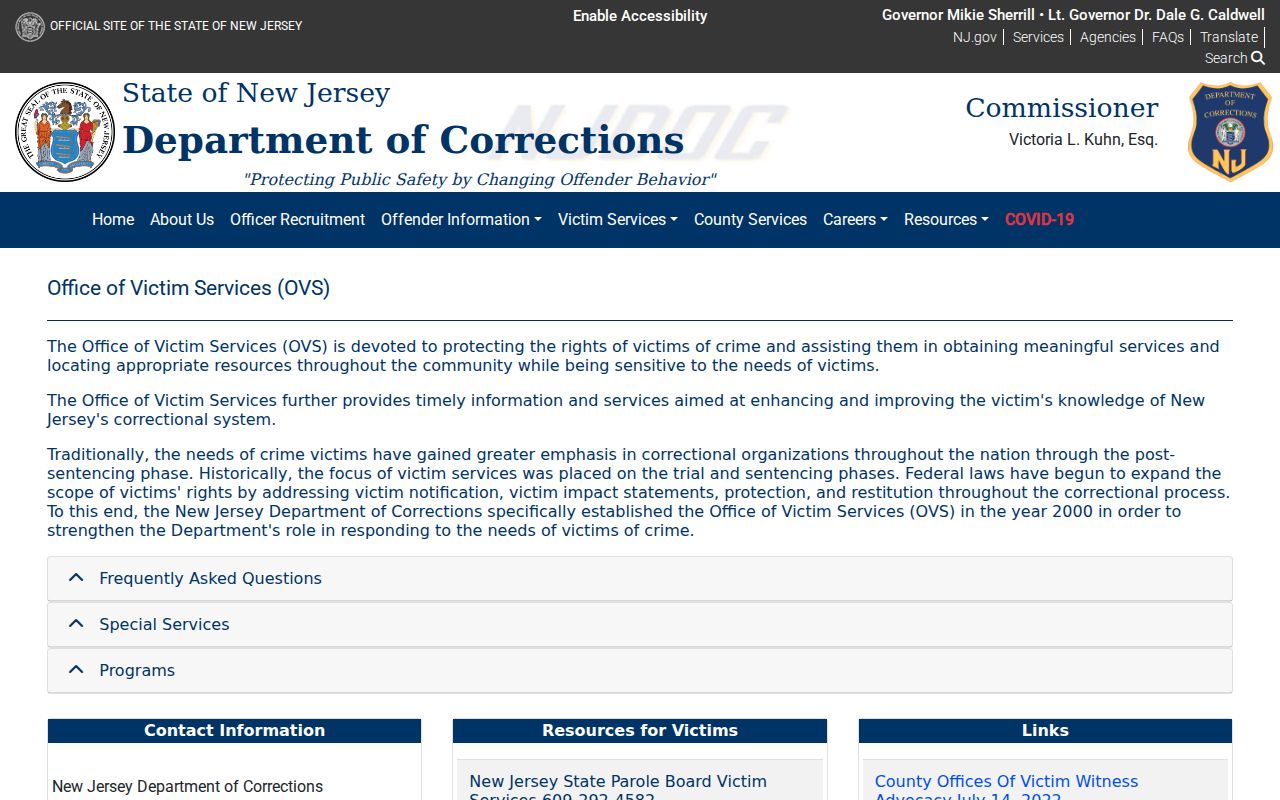
The state service complements county and VINE channels; it does not convert NJDOC's locator into a statewide booking roster.
| County detainee | County correctional facility or official local channel, plus VINE where supported |
|---|---|
| State sentenced person | NJDOC Offender Search Engine and NJDOC records channels |
| Parole status | NJDOC status where shown, then State Parole Board information or OPRA |
| Federal custody | Federal Bureau of Prisons locator and federal case sources |
What an Arrest Record Shows
A New Jersey arrest record can identify the agency, alleged offense, complaint, booking event, and custody path. The initial charges are allegations. They may later be amended, downgraded, dismissed, or resolved through plea or trial. Privacy rules often remove Social Security numbers, full birth dates, driver numbers, medical or security facts, victim and witness data, juvenile identities, and protected home addresses.
| Arrestee Name & Identifiers | Legal or alias name, physical descriptors, SBI or transaction identifiers where lawfully shown |
|---|---|
| Arrest Date & Location | Date, time, place, municipality, county, and incident number |
| Arresting Agency | Department, officer or ORI, and the agency that keeps the source report |
| Charges at Booking | Alleged offense descriptions, Title 2C citations, degrees, counts, and complaint type |
| Booking Number & Photograph | Local intake number and an identification image that is not automatically public online |
| Release Status | Release conditions, detainers, warrants, transfer, or bond if exceptionally ordered |
New Jersey Arrest Facts Under OPRA
N.J.S.A. 47:1A-3(b) separates basic public arrest facts from a complete investigative file. Within 24 hours or as soon as practicable, an agency generally provides the crime type, time, place, and weapon facts before arrest, then the defendant's name, age, general residence or background, charge text unless sealed, agency and personnel, immediate arrest circumstances, and release or bail circumstances. Safety, victim, next-of-kin, privacy, and investigation-integrity limits can still apply.
Send a narrow written request to the creating agency's records custodian. Ask first for the routinely kept face arrest report and statutory arrest facts. Identify narrative supplements, body-camera footage, CAD or 911 material, photos, or evidence as separate records. The Government Records Council exemptions index identifies common protected categories. OPRA does not force an agency to create a new report, and a criminal-investigatory exemption can persist after a case closes.
The Department of Law and Public Safety OPRA channel is the source for the official request interface shown here.
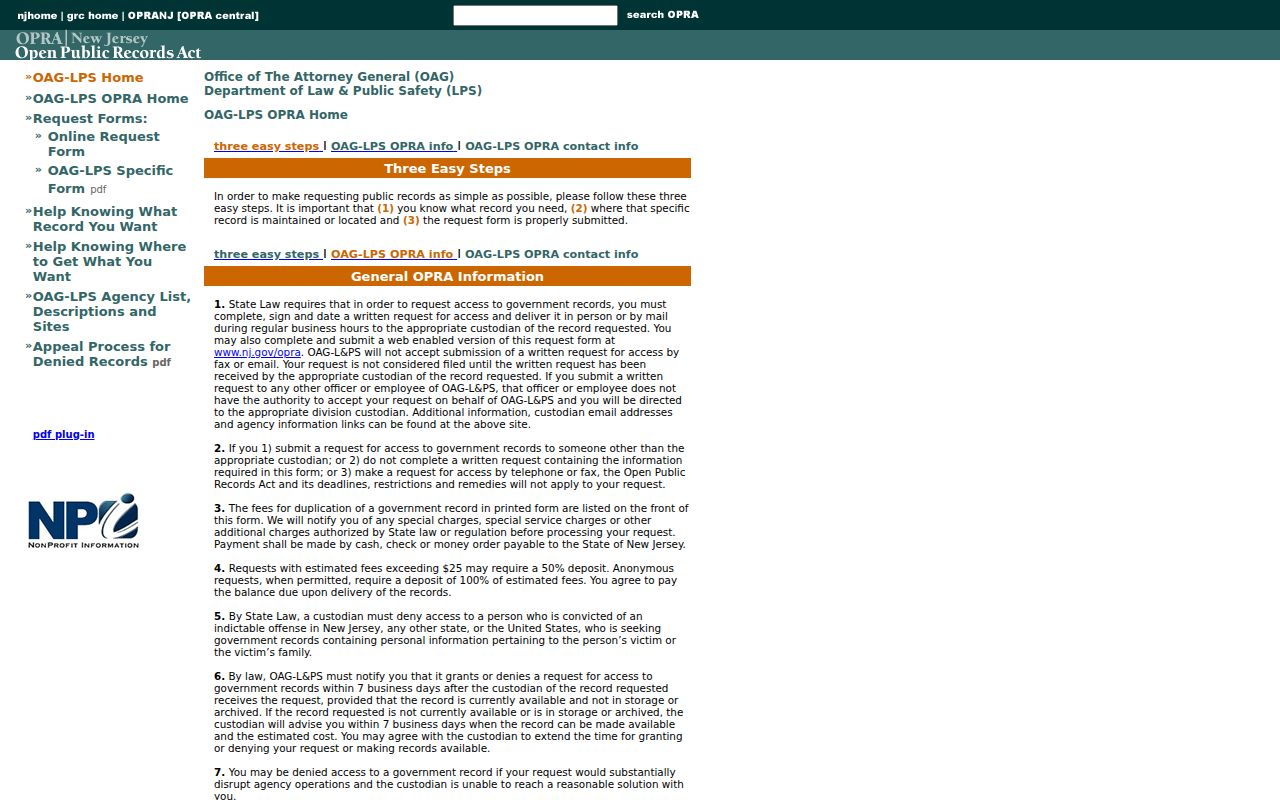
The agency-specific route reinforces a key rule: request an arrest report from the office that created or lawfully keeps it.
Note: An OPRA request for precise existing records is easier to process than a broad demand for every investigative item.
New Jersey Arrest Data Limits
The NJSP UCR Compliance Unit gathers submissions from New Jersey law-enforcement agencies, audits contributors, and sends data to FBI UCR. The state launched a new NIBRS repository in 2019. Current Crime Data remains preliminary. NJSP warns that zero may mean no reported crime or delinquent reporting, ancillary agencies may be absent, and contributing agencies control source accuracy.
A current verified annual all-arrest total was not found in the official dashboard research. The older 2016 legacy UCR report counted 430,818 arrests for all crimes, but that is a historical benchmark under an older reporting frame, not a current estimate. The 2023 NJSP annual figures count only State Police activity and must not be presented as all statewide arrests.
The NJSP UCR and NIBRS resource is the source for the program image below.
The reporting forms and repository links show why contributor status must accompany any New Jersey arrest trend or count.
Arrests vs Convictions
An arrest records government action based on an accusation. A conviction is a court judgment of guilt after a plea or verdict. New Jersey access rules treat source records differently: statutory arrest facts may be public through the arresting agency, court outcomes follow Judiciary rules, and SBI dissemination is limited to authorized channels. Always match the arrest cycle to the final charge and disposition.
| Arrest Record | Conviction Record | |
|---|---|---|
| Created by | Arresting agency and booking or custody office | Court judgment, then reported to SBI |
| What it proves | A person was arrested or processed on an accusation | Guilt was established by plea or verdict |
| Public access | Basic facts may be public; reports and photos face exemptions and redactions | Public court material follows Rule 1:38; SBI access remains restricted |
| Can it clear | Eligible nonconviction matters may qualify for expungement | Only eligible convictions qualify under statutory paths and exclusions |
Note: An arrest entry with no disposition is not proof of guilt; confirm the outcome in the New Jersey court file.
Expungement means covered records are extracted, sealed, impounded, or isolated rather than erased from history. New Jersey has relief for qualifying arrests that did not end in conviction, along with distinct paths for eligible convictions. After an order, confirm implementation in both the court system and a later personal SBI review. If an entry remains, contact the source court and NJSP rather than assuming every system updates at once.