
About the New Jersey State Police SBI
The State Bureau of Identification is an operating bureau within the Identification & Information Technology Section of the New Jersey State Police, Department of Law and Public Safety. SBI is the central repository for receiving, verifying, coding, processing, and disseminating New Jersey criminal history record information. Its authority rests in N.J.S.A. 53:1-12 through 53:1-20.6 and the dissemination rules at N.J.A.C. 13:59.
SBI is not a county office or a separate cabinet agency. The Superintendent of State Police is the statutory administrator, while specialized NJSP units run biometrics, record integrity, applicant services, system access, expungement work, and related checks. The repository's central identity record is based on fingerprints, not just a match between a name and birth date.
New Jersey State Police SBI Units
The Biometric Identification Unit maintains MorphoBIS AFIS and processes criminal and civil fingerprints and palm prints around the clock. It updates SBI and Computerized Criminal History identity records and forwards fingerprints to FBI Next Generation Identification. The Criminal Information Unit manages noncriminal applicant fingerprinting through the contracted IdentoGO network.
The CJIS Systems Control Unit manages secure access and connections to NCIC, NLETS, motor vehicle data, and the Interstate Identification Index. The Criminal Records Integrity & Compliance Unit quality-checks CCH records, operates court interfaces, reviews county prosecutor registry submissions, and links custody information. Separate Expungement, NICS, UCR compliance, and analytical functions address court orders, firearm-transfer checks, and statewide crime reporting. NICS is a specialized statutory service, not a general criminal history search.
The official IdentoGO scheduling source shown below is the state-contracted fingerprint appointment channel.
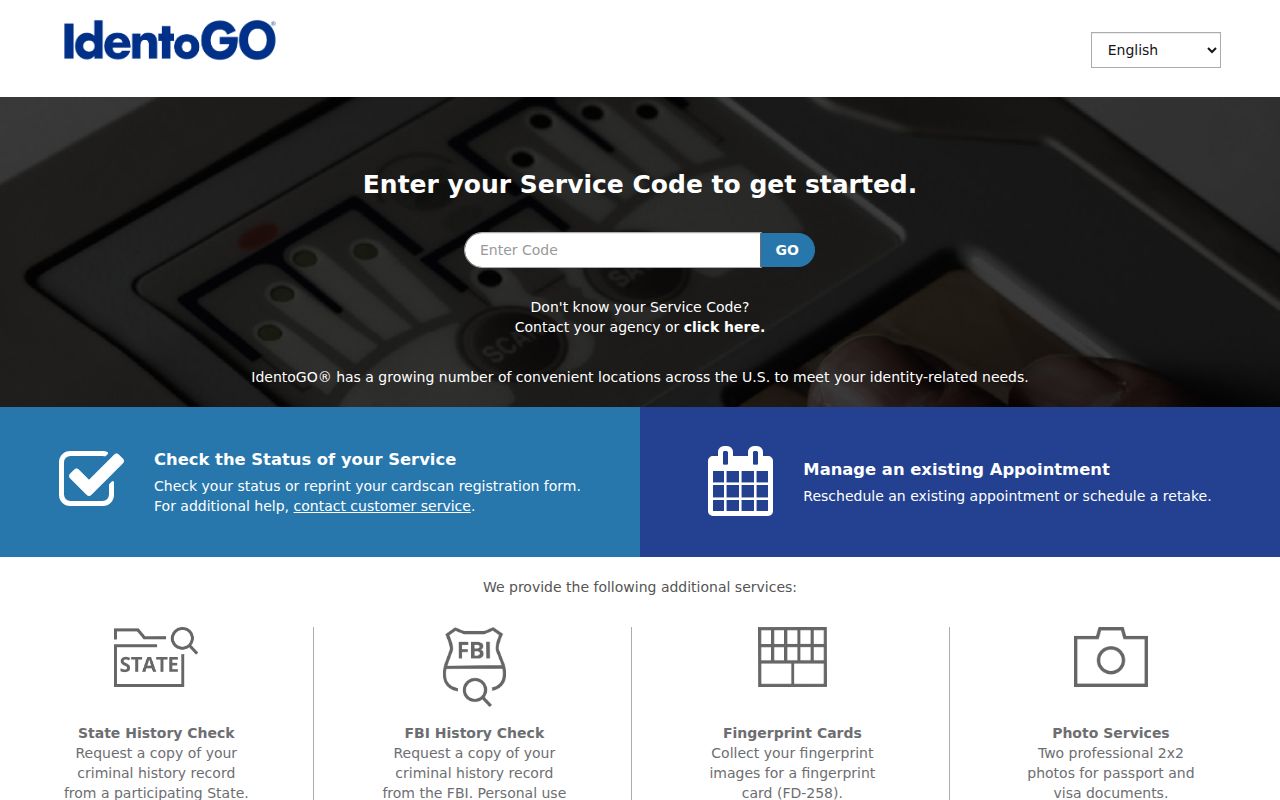
The service-code entry screen reflects why a requester must obtain the correct New Jersey program form before scheduling.
Criminal History Checks Offered by New Jersey State Police (NJSP)
NJSP does not offer one unrestricted public people search. Each New Jersey product has a defined requester, scope, delivery method, and price. Form 212A starts with an ORI supplied by the responsible police department or state agency. SBI 212B is limited to classes authorized by N.J.S.A. 53:1-20.6 and N.J.A.C. 13:59. Neither is the right route for a person checking their own record.
| Product | Who May Order | What It Returns | Cost |
|---|---|---|---|
| Online Form 212A | Filer directed by a police department or state agency with its ORI | New Jersey name-based CHRI sent to that agency | $20 |
| Online SBI 212B | Authorized government, qualifying organization, volunteer program, or licensed private detective channel | Permitted New Jersey name-based response; subject approval normally required | $20 standard; $12 qualifying volunteer |
| In-state Personal Record Request | The New Jersey resident who is the record subject | Fingerprint-based New Jersey record for review; no-record download or mailed record | 2025 materials list $44.13 |
| Out-of-state Personal Record Request | The record subject outside New Jersey | Fingerprint-card-based New Jersey personal record | Current universal amount not stated |
| Statutory Live Scan check | Person in an agency-authorized program | State-only or state-and-FBI result defined by service code | Program-specific |
| FBI Identity History Summary | The record subject | National fingerprint-index summary through the FBI electronic portal | $18 direct; channeler total varies |
Note: A fee from one New Jersey service code does not establish the charge for a different NJSP fingerprint program.
New Jersey State Police Form 212A
Form 212A is not a personal record review or a public curiosity search. The responsible local police department or state agency gives the filer an ORI. That code controls the authorized purpose and where the response goes. A wrong ORI can block processing, and the $20 payment is not refundable. NJSP sends the CHRI to the responsible agency, not to the filer.
The official form accepts Visa, MasterCard, Discover, and American Express credit or debit cards. After ORI validation, it collects legal identity details, the controlled transaction information, certification or consent, and payment. A person seeking their own New Jersey file should start with the fingerprint-based Personal Record Request instead.
Note: Never reuse an ORI from another New Jersey transaction; confirm the code with the agency responsible for the current request.
How Records Flow Into the New Jersey State Police (NJSP) Repository
A New Jersey arrest starts with a municipal, county, campus, transit, port, or state police agency. At booking, Live Scan commonly captures fingerprints and palm prints with a digital mug image. NJSP reported 720 Live Scan devices as of January 2024. AFIS searches the prints, confirms or creates the SBI identity, updates CCH, and transmits the fingerprint record to FBI NGI.
Data flow: County Arrest › Fingerprint Submission › New Jersey State Police SBI › Court Disposition Reporting › Rap Sheet
County prosecutors initially enter indictable charge data in PROMIS/Gavel. Superior Court Criminal Part staff add events, judgment, and sentence after indictment. Municipal courts send outcomes through the Automated Complaint System interface. NJDOC information also reaches CCH. Those links improve the New Jersey record, but they do not turn a rap sheet into a court case jacket, police narrative, or jail log.
Note: A New Jersey court docket can change before its latest disposition is linked to the NJSP criminal history record.
New Jersey State Police Workload
The 2023 NJSP Annual Report described about 985 criminal justice agencies connected through more than 20,000 terminals. It counted 125,132 criminal-arrest fingerprint submissions, 728,322 total fingerprint submissions, 562,080 applicant and noncriminal submissions, and 142,269 name-based SBI 212 checks. These figures count work events, not unique people, arrests, or convictions.
The AFIS Tenprint database holds more than 8 million fingerprint records and more than 1 million palm-print records. The scale helps explain why the fingerprint is central to the New Jersey repository. It also explains why a name-only match should not be treated as equal to an identity-based personal review.
How to Order a New Jersey State Police (NJSP) Check
Begin with the question the record must answer. A person reviewing their own New Jersey history uses the Personal Record Request. A filer acting through an authorized agency follows 212A and its ORI. An authorized 212B requester follows the subject-approval workflow. A state-and-FBI statutory check uses the service code provided by the responsible program.
- Select the NJSP product that fits the lawful purpose. Do not substitute 212A or 212B for personal review.
- Obtain the required ORI, service code, consent, subject details, or fingerprint form from the responsible official program.
- Submit through the named New Jersey portal, mail route, or IdentoGO Live Scan appointment.
- Pay the product's stated fee and retain the receipt, confirmation, and PCN or TCN when fingerprints are taken.
- Read the result as a summary, then obtain the county court file for full detail on any case entry.
The NJSP Personal Record Request retrieval source shown here uses the fingerprint receipt to authenticate an eligible result.
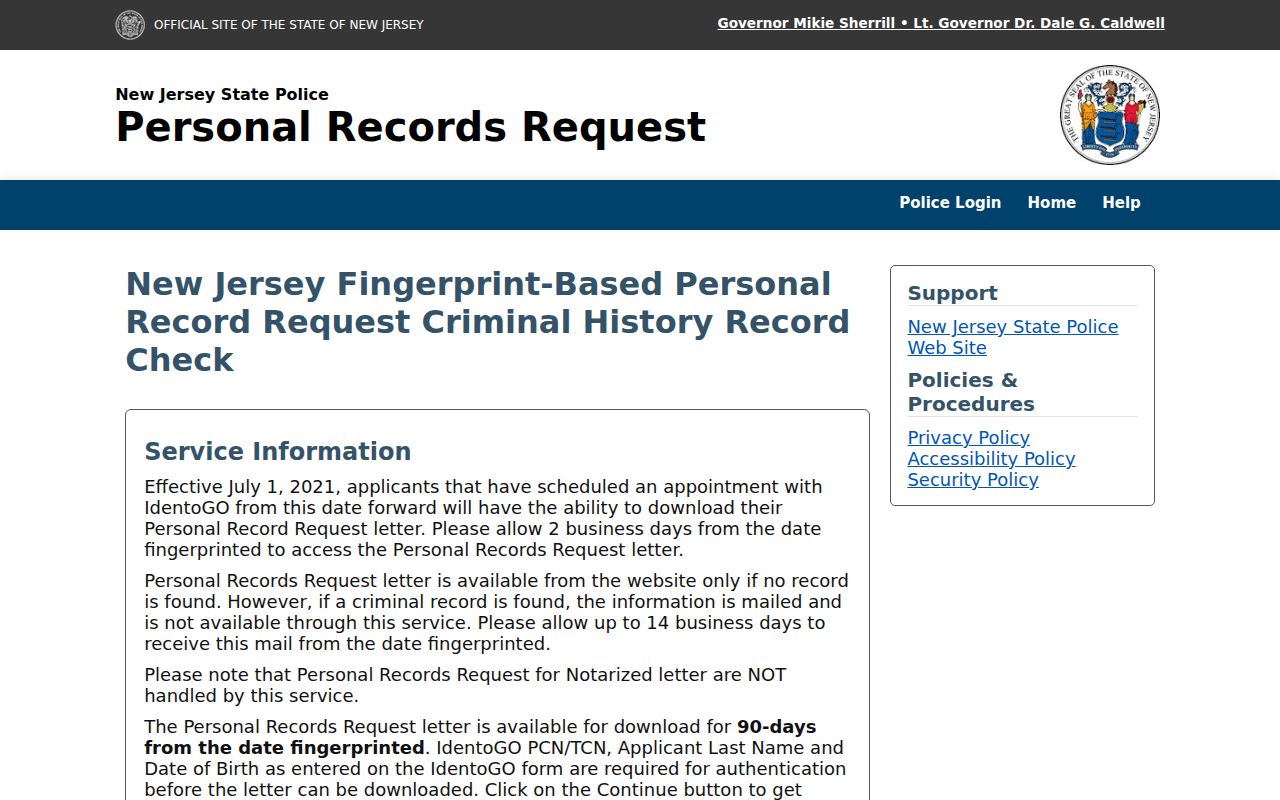
The retrieval route asks for the PCN or TCN, applicant surname, and date of birth, and it provides electronic access only to an eligible no-record letter.
New Jersey State Police SBI 212B
SBI 212B provides a New Jersey-only name-based response to an authorized requester. It is not an FBI summary, a case jacket, a county jail roster, or a self-review route. The subject normally receives an approval email and reminders. If approval does not arrive within seven days, the request lapses and the card is not charged. Either party may pay.
The first screen records purpose, business or requester name, matching email fields, phone, and a domestic or international address. Later screens collect the subject's name, date of birth, Social Security number, and descriptors. Account users can check status and download the Blue Form or result for 90 days. The FAQ says record-found documents for an unregistered transaction are mailed.
The official SBI 212B source shown below is restricted to the authorized New Jersey workflow.
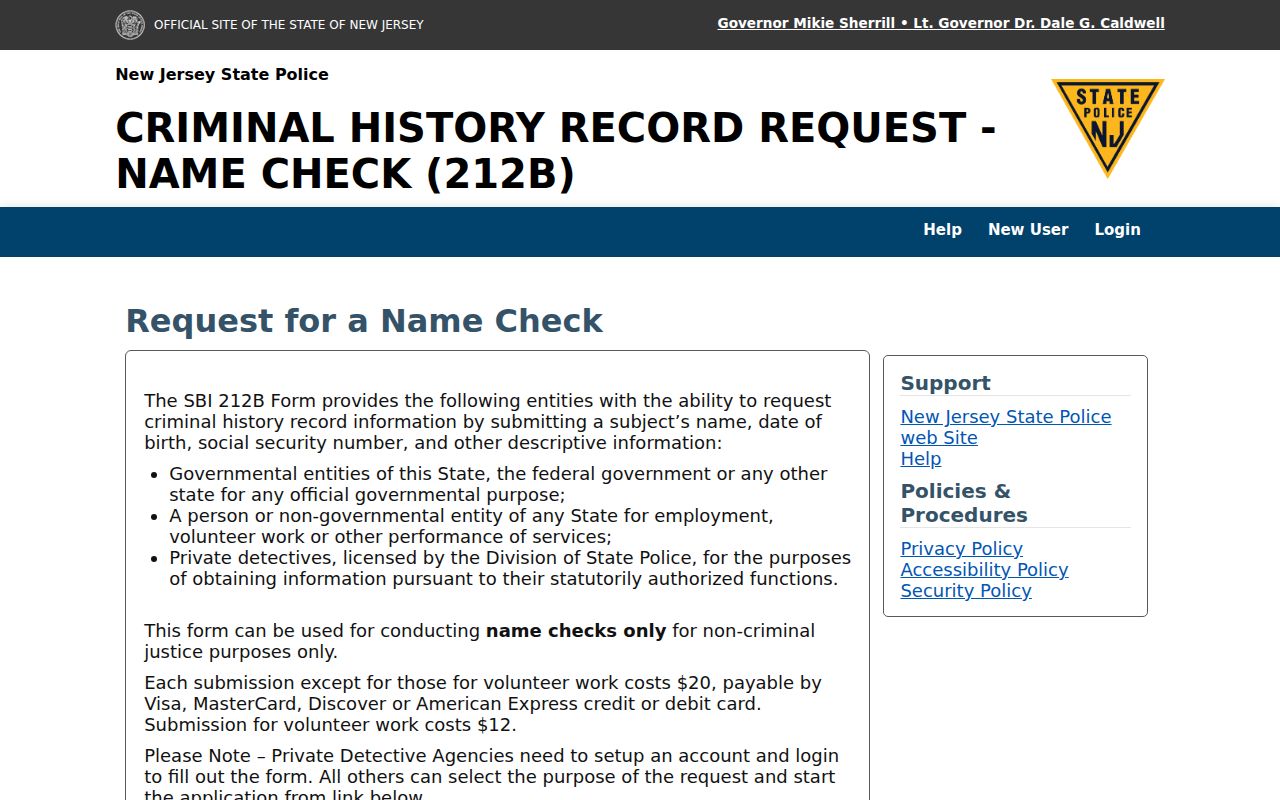
The portal entry reinforces that subject approval and statutory eligibility come before access to a New Jersey response.
The NJSP 212B FAQ shown here documents fees, timing, account status, and delivery rules.
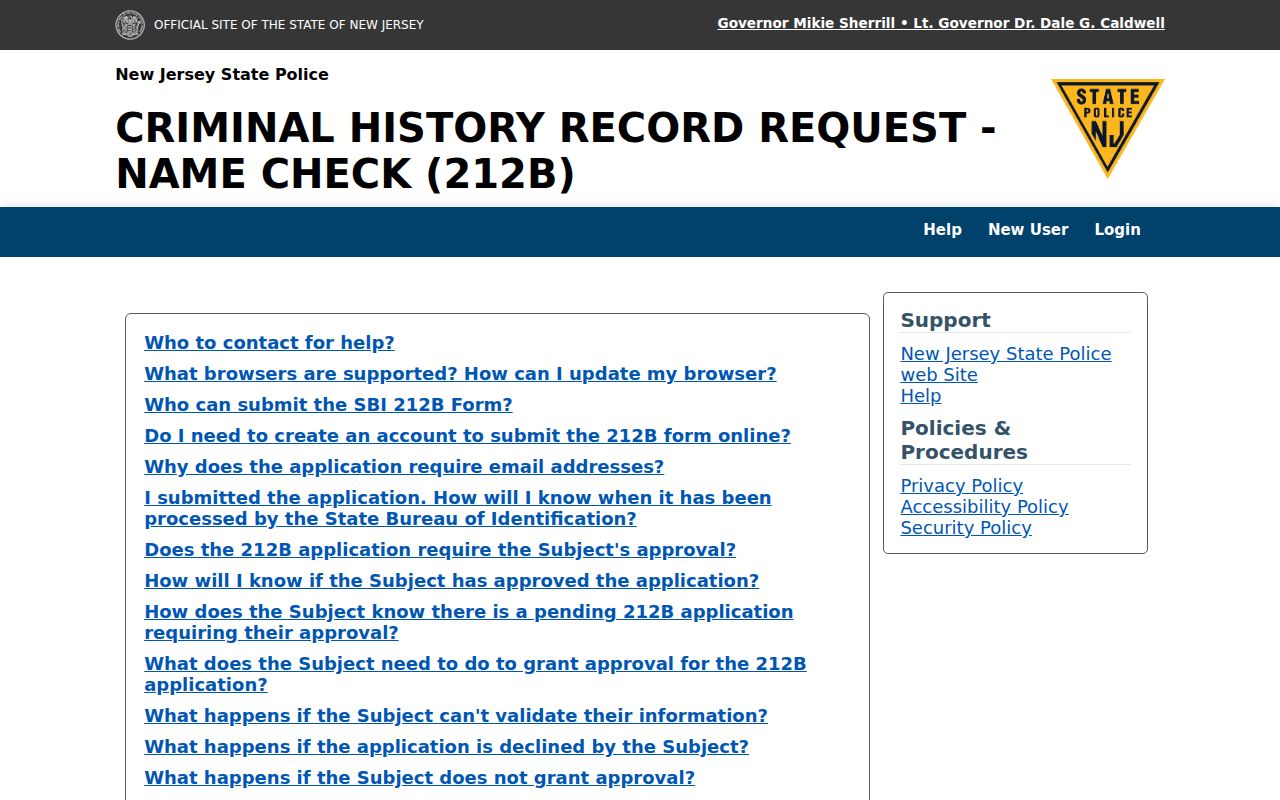
The FAQ is the better source when a New Jersey request is waiting for approval or when the delivery path is unclear.
Note: SBI 212B returns permitted New Jersey information only and should never be read as a nationwide fingerprint history.
New Jersey State Police (NJSP) Checks vs County Records
An NJSP rap sheet compiles fingerprint-linked arrest cycles and reported outcomes across New Jersey. A county file preserves the original case events and documents. The court docket may be newer, show financial entries, or contain a correction before CCH does. Conversely, NJSP may join fingerprint submissions that a same-name search misses.
| NJSP Check | County Records | |
|---|---|---|
| Coverage | Statewide identity history across 21 counties | Arrests and cases created in one county |
| Source | Fingerprint-backed CCH and reporting interfaces | Original police, court, prosecutor, and jail records |
| Freshness | May wait for source reporting or linkage | Updates as the local case moves |
| Detail | Compiled arrest and disposition summary | Docket events, filings, judgments, and local records |
| Best for | Reviewing statewide identity-linked history | Confirming the source and full context of one entry |
Use the New Jersey county directory to reach the court or creating agency. Neither source replaces the other when a result is incomplete or disputed. A PROMIS/Gavel case file is not an NJSP rap sheet.
New Jersey State Police Missing Dispositions
NJSP does not publish a current statewide disposition-completeness percentage, so none should be inferred. A missing outcome may result from a fingerprint or demographic mismatch, a municipal linkage problem, source-agency lag, a pending event, expungement, or incorrect source data. The safest response is to compare the fingerprint-based personal record with the court's judgment.
The agency's missing-disposition project had reviewed 958,874 cases and updated, flagged, or linked 274,664 by the 2023 report. Those are reconciliation counts, not a defect rate. If a New Jersey disposition is absent, obtain the county or municipal court record, secure a certified disposition when needed, and send the correction inquiry to the NJSP Criminal Information Unit.
New Jersey State Police SBI Milestones
SBI was established in 1930 under the predecessor to N.J.S.A. 53:1-12. AFIS began in May 1990 and shifted the bureau from paper-card classification toward rapid biometric matching. Live Scan later made most criminal fingerprint, palm-print, and mug-image submissions electronic. PROMIS/Gavel and municipal court interfaces then moved dispositions back to the repository without the former paper flow from 21 county courts.
Online SBI 212B launched on October 14, 2016. A new NIBRS repository followed in 2019. Personal no-record downloads apply to fingerprints taken from July 1, 2021. A March 2021 through June 2022 project digitized material from 1,119 filing cabinets, supporting archival access and expungement processing. CJIS replacement work that began in 2015 had reached statewide rollout by the 2023 report.
Note: These milestones changed New Jersey record processing, but police, courts, corrections, and NJSP still retain distinct source records.
Correcting Errors in Your New Jersey State Police (NJSP) Record
A New Jersey resident should begin with the fingerprint-based Personal Record Request instructions, not a 212A or 212B name check. The correct service code and universal fingerprint form come before an IdentoGO appointment. Current program guidance describes 18 static sites, appointments within seven days, and capture in about ten minutes. One official state program instruction documents the current components, but the service-code screen controls the fee.
- Order your own NJSP fingerprint record and keep the IdentoGO receipt with its PCN or TCN.
- Compare each New Jersey arrest cycle and disposition with the record held by the arresting agency and court.
- Obtain a certified disposition if needed and send the correction material to the NJSP Criminal Information Unit.
- After the source and NJSP act, order or retrieve a fresh record to confirm the corrected entry.
No-record letters may become available about two business days after fingerprinting and remain downloadable for 90 days. When a record exists, NJSP mails it; current guidance allows up to 14 business days. Federal or out-of-state errors must go to the FBI or the jurisdiction that supplied them.
New Jersey State Police Expungement Status
A granted New Jersey expungement order still must reach and be processed by NJSP. The Judiciary's eCourts Expungement user guide covers filing, while NJSP handles repository implementation. In 2023, the agency received 60,032 expungement orders and processed more than 43,000 final orders. A March 2025 settlement set a 120-day outside target from June 1, with best efforts toward 90 days.
The NJSP Expungement Status Portal shown below lets a person track a granted order by its XP number.
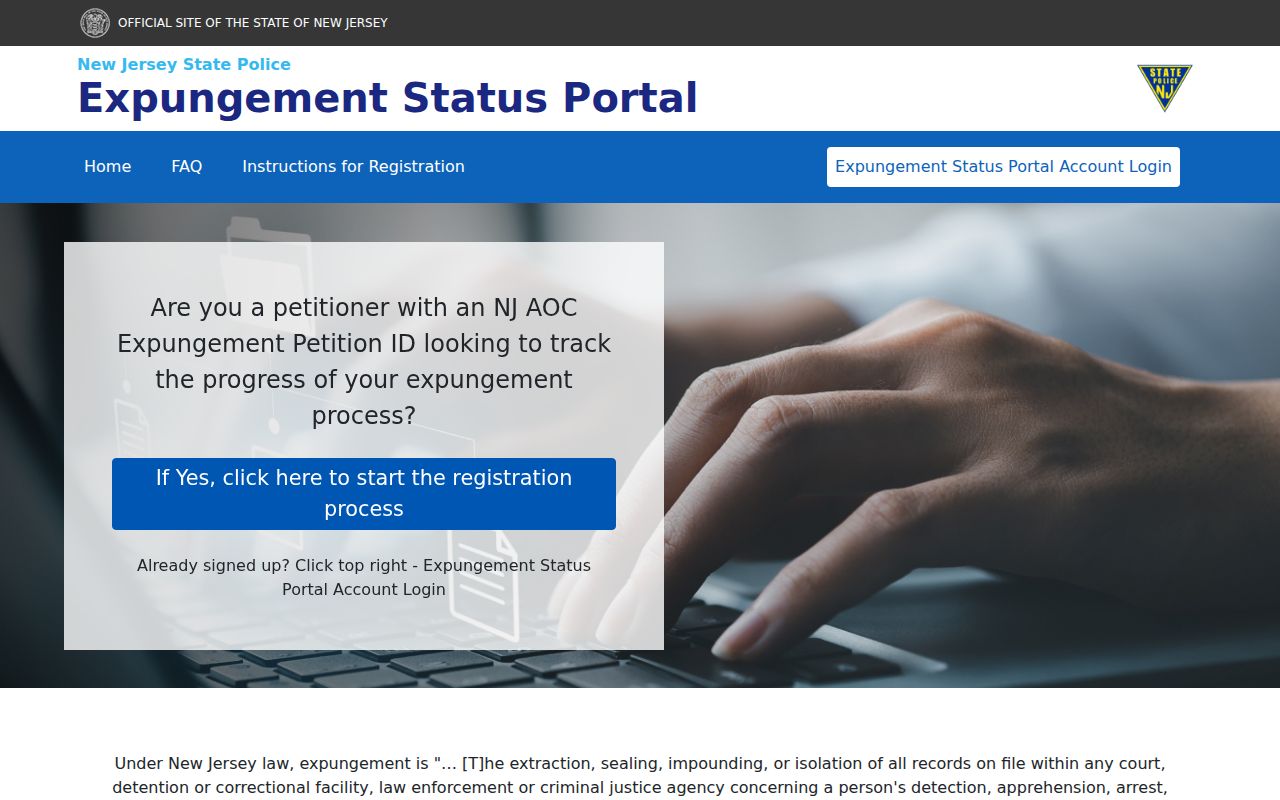
A portal status of complete confirms NJSP processing; it does not change the separate court order or every record held outside the repository.
Until processing is complete, an entry can still appear in an NJSP fingerprint response even though the court granted relief. The right check is the portal status followed by a new personal record, not an assumption based on the date of the order.